
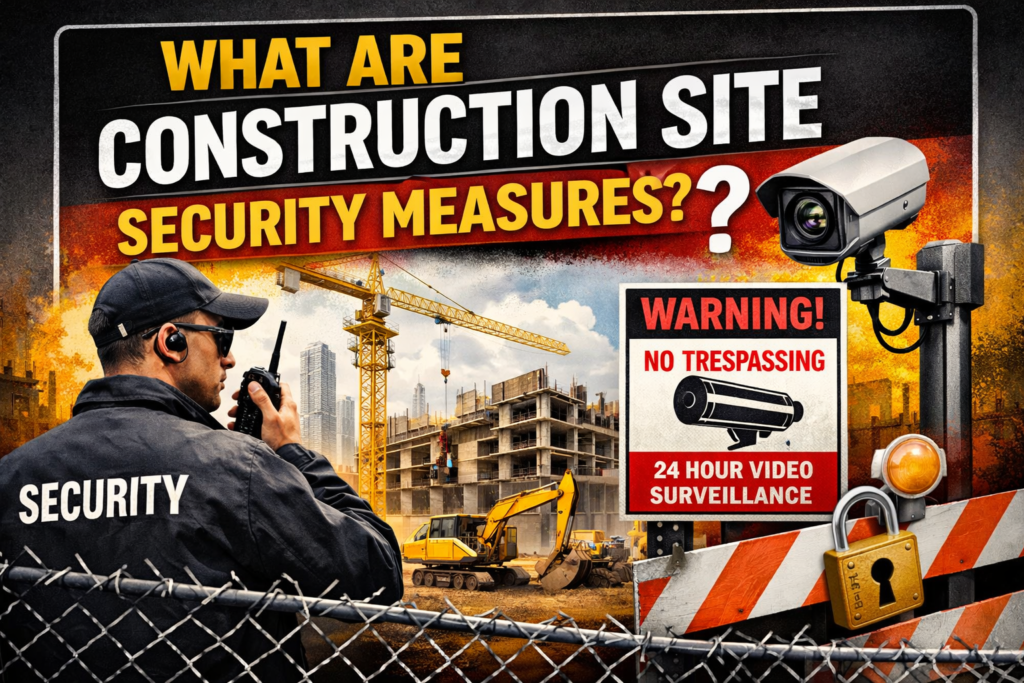
Construction sites are hectic in nature. Workers are arriving and leaving, equipment is moving around, materials are getting deliveries and deadlines that do not leave much room to make any mistakes. Nonetheless, when the day is slowed down, another issue is equally significant as progress, which is security.
Copper, machinery, fuel, wiring and temporary structures can be all in a single location within a construction site. That contributes to its vulnerability to thieves, vandals and trespassers. And above all, construction has already been a risky industry, and the construction guidelines offered by us include fire prevention, lighting, housekeeping, first aid, and overall safety practices since the job sites inherently involve significant risks.
This is why Construction site security does not only involve preventing theft. It is equally related to the protection of workers, access control, mitigation of liability, assistance of safety measures, and maintenance of the project timeline. The loss of one set of tools might seem just a minor detail at first, yet in a real sense will cause delays among crews, postponed check-ups, higher expenses, and frustration amongst the entire project crew.
This guide describes what construction site security measures are, the way they operate and the solution that suits various forms of projects. Provided you are in charge of a residential construction, commercial building, renovation or an industrial facility or municipal project, this article will assist you in creating a smarter and more feasible security plan.
Construction Site Security Measures
Security measures at construction sites refer to the systems, personnel, rules, and physical barriers that are applied to ensure that a job site is not disturbed by theft, vandalism, trespassing, fire incidents, and other forms of disruption that can be prevented. To put it in simple terms, they are the measures implemented towards safeguarding the site, the individuals working on the site and the funds that were spent on the site.
When someone hears the term security, they only imagine that they are talking about guards at the gate. As a matter of fact, good site security is a lot more than that. It may involve access control, perimeter checks, visitor logs, security lighting, surveillance cameras, patrol cars, incident reporting, emergency response support and fire watch coverage. Combinations of these are the best plans rather than relying on a single one.
This is important since the construction sites are never the same. The next month, the illegal entry of visitors into the property can be considered a significant issue. Some weeks after, there is a possibility of more valuable materials or equipment being added to the site; this increases the chances of theft. Subsequently, further deliveries, additional subcontractors, visitors, and pressure to secure what has already been done may enter the picture later in the project.
That is, security measures on construction sites are not fixed. They are supposed to develop and adapt to the location.
What Security Threats Do Construction Sites Face?
To select a security plan, it is always wise to know what the site should be guarded against. Security and safety risks are not the only risks involved when carrying out most construction projects.
Theft
One of the most important issues at construction sites is theft. Tools, generators, fuel, copper wiring, HVAC systems, attachments to heavy equipment and even pallets of building supplies can be stolen shortly when the site is not secured. One theft made at night can have multiple trades simultaneously. Crews report to work only to realize that the equipment/materials they require are missing.
Vandalism
Vandalism may appear to be less serious compared to theft, yet it will be the cause of significant delays. Broken locks, spoilt fencing, graffiti, cut wiring, and damaged materials are time and money costs. On other sites, vandals are not even attempting to steal. They just cause havoc.
Trespassing
Another area of common problems is trespassing. Other individuals visit a site by chance. Some enter to seek refuge, rags, or an opportunity to rob. In any case, there are unprotected individuals on a construction site and this poses hazards and liability risks. The unsanctified property is not safe to the people and particularly where there are scaffolding, trenches, tools or unstable grounds.
Fire Risks
Construction sites are likely to have temporary power, welding, cutting, exposed materials and reconfiguring site conditions. We specifically address fire protection and prevention, illumination, housekeeping, first aid, and related safeguards because these are real and recurring jobsite concerns.
Safety and Emergency Concerns
Not all the risks are external. The security issue is sometimes internal: there is a blocked exit, it is dark, a tool-storage area is left unsecured, there is a gate that is not secured, or there is a mix-up during an emergency. These problems can be detected early through good security measures.
So when people ask, “What are construction site security measures?” the better question is, “What problems are those measures designed to stop?” The answer is simple: loss, disruption, injury, liability, and delay.
Why Construction Site Security Matters for Budget, Schedule, and Reputation
Building projects are normally time-bound. Every day matters. This is the reason why security issues may prove to be more costly than it initially seems.
Suppose that some materials are stolen on Friday night. The crew is not able to work as usual on Monday morning. New materials should be ordered. Reports should be submitted by supervisors. Deliveries shift. Subcontractors wait. Timelines move. All of a sudden, one incidence influences the labor expenses, coordination of the project and client trust.
This is the same case with vandalism. The damage can be required to be cleaned, fixed, reinstalled, or reinspected. Even a mere effort at break-in may compel the management to check the access points, rekey locks, and waste time resolving an issue that was not supposed to occur.
There is the problem of reputation as well. The owners, developers and the general contractors desire projects to be organized and controlled. A site that appears to be ill-maintained sends the wrong impression. Meanwhile, a site that has professional security measures down appears more serious, more stable and better prepared.
That is why Construction site security guard services are not the added value. They tend to be involved in the safeguarding of the project itself.
What Roles Do Construction Site Security Guards Play?
Security guards do not just stick to a gate. Their efforts on a construction site are practical, visible and continuous. They are related to preventing the issues before they occur and also reacting to the issues when they arise.
On-Site Security Guards
These are the guards that come to mind of many. Their presence is on-site, patrolling of critical areas, access points checking, and monitoring daily activity and responding to incidents. Depending on the property layout, they can be positioned either at entrances, where there is storage of materials or high traffic places.
They are to keep the shift in check and alert. That involves monitoring suspicious activity, inspecting fences, verifying guests, recording problems, and calling supervisors or emergency call services as necessary.
Armed and Unarmed Security Guards
In the construction security plan both can be included based on the level of risk.
Security guards are normally deployed as unarmed personnel to perform access control, patrols, visitor control, and overall presence of the site. They tend to fit perfectly well in low- to medium-risk settings in which good observation and regular reporting are the primary concerns.
Higher-risk sites, or the location of valuable equipment, or projects with a higher threat level may be better served with armed security guards. Their existence can be more of a deterrent. The selection will be based on the location, needs of the client and local needs.
Front Entry or Reception-Style Guards
Other larger projects require a visitor-oriented guard who has visitors, subcontractors, deliveries, and entry as his primary focus. This position comes in particularly handy on the sites that have numerous moving elements and also a lot of individuals who visit it on a daily basis.
Gate Access Guards
At locations where cars keep on coming with materials or equipment, it becomes significant to control at the gate. These guards assist in tracking the entry, exit, the deliveries that are made, and whether one is an authorized user.
In brief, guards contribute to the establishment of order. And at building sites order is a kind of protection that is most powerful.
How Do Guards Keep Construction Sites Secure Day to Day?
The actual worth of guards is reflected in the daily work that they perform on a shift basis. Security is not often a dramatic event. More frequently, it concerns avoiding dozens of minor problems that will make costly ones.
Foot Patrols
One of the most significant site security procedures is foot patrols. Patrol enables the guards to conduct a physical check of the property as opposed to using cameras and guesses alone. A guard may check in these rounds:
- fences and perimeter lines
- gates and lock points
- material storage areas
- trailers and temporary structures
- parked equipment
- lighting conditions
- signs of tampering
- hazards that could create safety issues
A gate can be portrayed by a camera as closed. Foot patrol will indicate whether the latch is loose, the chain is loose, or the fence adjacent to it was cut.
Access Control
Another significant component of security in a construction site is access control. It involves making decisions of who goes where and at what time and under what conditions. There is no access control, and almost anyone can enter and leave without being noticed.
An example of a simple access control routine can consist of procedures of signing in, identification, visitor log, delivery verification and restricted zones. It can also involve vehicle access control and escort on huge sites.
Incident Response
In the event of an occurrence of something out of the ordinary, guards are usually among the initial responders. That can include dealing with a trespassing case, reporting a suspicious act to the site management, assisting in case of a medical emergency, or securing the place after a break-in.
Documentation and Reporting
Reporting is one of the least considered aspects of security. Comprehensive reports provide an account of what took place, when, who was there and what was done. They can be used to make management decisions, insurance issues and subsequent planning.
The best guards do not just “show up.” They observe, respond, and document.
What Physical Security Measures Should Every Site Have?
Guards are noteworthy but they perform optimally when there are physical site safeguards. Practical barriers and visible deterrents must always be involved in construction security.
Fencing and Controlled Perimeters
The first defense line is a defined perimeter. Fences assist in demarcation of the site boundary and render trespassing difficult. More to the point, they demonstrate that the site is controlled. Loose or ineffective perimeter lines are welcome.
Locked Gates and Storage
End of shift lockout should be done by locking gates, lockboxes, trailers and storage containers. Guards and cameras may be present at a site but when tools and fuel are not well kept in place then a lot of risk is high.
Lighting
The OSHA construction regulations have light regulations, and a security perspective OSHA is light, which is one of the easiest and most effective solutions. Proper lighting assists employees to move without any difficulty, enables visibility of cameras and limits dark spots where individuals can conceal themselves. (osha.gov)
Warning Signage
Trespassing can be discouraged by visible signage and access policy reinforced. There can be signs of restricted areas, emergency contact, hours of site and surveillance use. Signs are not sufficient to win a site but they are part of the greater mechanism.
Organized Storage Areas
The sloppy site is less secured. Clean walkways, propelled materials and marked places of storage are some of the items that can be easily identified as missing, tampered and potential hazards. Another provision of OSHA is housekeeping in construction standards which aids in safety as well as site control. (osha.gov)
How Does Surveillance Help Protect a Construction Site?
Surveillance also contributes to added security as it will assist the teams to watch over the site even when guards are not present in all the areas simultaneously.
Areas addressed by cameras can include exits, storage areas, parking, trailers, areas of blind spots, and boundaries. They are able to facilitate the real time observation or capture videos to view later. In both instances, they assist the management to have an eye on the property.
Surveillance may also come in handy in a number of manners. First, it acts as a deterrent. When individuals are aware that they can be caught, the chances of trespassing and stealing are reduced. Second, it assists in validating what transpired in an incident. Third, it aids guards by spreading the knowledge over a more significant area.
Nevertheless, it does not mean that cameras can be regarded as full substitutes of people. Cameras will be able to monitor activity, but cannot physically intervene, investigate something suspicious, escort a person off-site or help respond to an emergency, as a trained guard can. This is the reason why a lot of good security arrangements involve monitoring people along with their staff.
What About Vehicle Patrol for Construction Sites?
When it comes to large locations, multi-building properties, or industrial yards, vehicle patrol works best, as well as in properties that require off-hour coverage but do not need a full-time task force in every location.
The patrol unit is able to walk around the perimeter, search the entry points, look at evidence of forced access, and establish a visible security presence. The patrol cars are also useful in the night during the holiday period or on weekends, when the site is not busy and the chances of theft are high.
This type of service works well when:
- the site is too large for one fixed post
- different sections need to be checked regularly
- overnight visibility matters
- management wants a cost-effective added layer of coverage
Vehicle patrol is not a replacement of all other services, yet it may enhance the overall plan, particularly on-site guards or surveillance.
How Does Fire Watch Fit Into Construction Site Security?
When individuals consider site security they tend to only think about theft and trespassing. Nevertheless, fire hazards may be equally severe. Examples of areas with hot work, temporary electrical systems, stored material, limited finished infrastructure, or areas with alarms and fire systems incomplete include a site.
That is where Fire Watch becomes important.
Fire watch operators are used to patrol the high risk areas and monitor the early symptoms of smoke or heat problems, assist in evacuation, and report such issues before they turn into emergencies. Fire watch can also be required in some projects at specific stages or when the systems are offline.
This service is important since the destruction of materials is not the only cause of fire damage. It has the ability to stop the work process altogether, initiate inquiries, postpone inspections, and cause significant liability. Prevention is the most suitable answer in most instances.
How Do Security Guards Support Safety and Emergency Response?
People may not appreciate the fact that security and safety overlap. The position of a guard is not identical to the role of a site superintendent or safety officer, but a trained security presence can still contribute to the day to day safety work in extremely practical manners.
Guards are able to observe blocked exits, unsecured access points, inadequate lighting, spilled materials, fencing that is loose, suspicious areas, and activity in the site that is abnormal. They will be able to report such problems promptly and allow the management to correct them before injuries or delays are caused.
In an emergency, guards may help by:
- calling emergency services
- guiding first responders to the correct location
- helping direct evacuations
- keeping access lanes clear
- documenting what happened
- helping maintain calm at entry points
This is one reason Construction site security guard services can be valuable even beyond crime prevention. They support overall site control.
What Security Measures Work Best Overnight, on Weekends, and During Holidays?
Workers have often been absent at construction sites making them most vulnerable. Nights, weekends, holidays present the perfect occasion of undesirable activity since the number of people who may easily report a problem is minimal.
A good off-hour security plan may include:
- mobile patrols
- surveillance monitoring
- locked storage procedures
- stronger lighting at high-risk points
- alarm response protocols
- overnight on-site guards for higher-risk properties
Precise combination varies with the location. The patrol coverage after hours is sufficient in some projects. Full on-site coverage might be necessary to other people because of high-cost materials, previous occurrences, or more access points.
The point is as follows: the level of security should correspond to the level of risk of the site at each stage of the week, not only at work time.
How Do You Choose the Right Level of Security for Your Site?
All sites do not require the same plan. A small residential project will not require the same needs that a big commercial construction will have. This is the reason why a realistic evaluation should be the starting point in the selection of security.
Ask questions like these:
- How large is the site?
- How many access points need control?
- Are high-value materials or equipment stored there?
- Is the site in a busy urban area or a quieter location?
- Has there been prior theft, vandalism, or trespassing?
- Are deliveries constant throughout the day?
- Are there temporary fire risks or safety concerns?
- Does the project phase change the risk level?
- Would cameras, patrols, or gate control strengthen the plan?
This is not aimed at doing security too many times or too little. It is aimed at aligning protection to the real-life requirements of the site.
What Services Are Commonly Used in a Complete Security Plan?
An effective construction site security plan tends to incorporate a number of services as opposed to a single one.
Armed and Unarmed Security Guards
Applicable to on-site presence, patrols, access control and response.
Surveillance
Beneficial in the continuity of visibility, documentation of evidence, and expansive coverage.
Security Guards Services
There is a complete guard service plan that may involve posts, patrols, reporting of incidents, checking on visitors, and providing emergency support.
Vehicle Patrol
Works in large properties and conducts after-hours inspections.
Fire Watch
Significant to the high-risk stage, interim systems and prevention assistance.
Event Security Guards
Convenient when the location where the event is to be launched, a meeting of the people, inspection, ceremony, or high attendance is to occur.
Bodyguards and Executive Security Services
Useful when owners, executives, investors or high-profile individuals require personal protection whilst they visit the location. Such services are not add-on services. The solutions to each of them are different in nature.
How Should You Choose a Construction Security Provider
The quality of a security plan is dependent on the firm that supports it. The selection of the appropriate provider is equally important as that of the appropriate services.
Find a company that knows the environment of construction, as opposed to general security. Construction sites do not resemble a retail store, commercial building or residential neighborhood. They are dynamic in nature, stand on both sides and require versatile coverage.
A good provider should offer:
- experience with construction projects
- trained guards
- clear communication
- reliable reporting
- flexible service options
- strong response procedures
- broad area coverage if you manage multiple sites
It is also beneficial when the provider can put up services as the project evolves. Needs at the early stages of the site and active build needs are distinct, and needs may shift once more following the construction.
How Already Security Can Help
So, what are construction site security measures?
They are the action steps that ensure that a working site is secure, clean and prepared to proceed without any unnecessary delays. These are visible deterrence, access control, professional security staff, surveillance, perimeter security, after-hours patrols, fire watch support, and effective reporting procedures.
An appropriate solution is never a one-size-fits-all solution. A limited construction can require a basic and narrowed-down plan. There are more layers that may need to be worked on in a larger project. In any case, it is all about the same goal: the protection of workers, the protection of assets, the protection of the schedule and the protection of the investment in the project.
Ultimately, sound site security is not simply a way of minimizing risk. It assists in smooth running of the entire project.
In Already Security we realize that each construction site should have a security plan that fits into its layout, schedule, and risk level. We offer Armed and Unarmed Security Guards, Event Security Guards, Surveillance, Security Guards Services, Bodyguards, Fire Watch, Executive Security Services, and Vehicle Patrol to help in providing a safer and more controlled job site. As a Woodland Hills based company, we are proud to serve the whole of California, such as San Fernando Valley, Los Angeles County, Orange County, Riverside County, San Diego, Ventura County, San Gabriel Valley, Santa Barbara County, Kern County, and San Bernardino County.